Special report · Sunday 1 November 2026
Risk everywhere but midterms won’t change much
The most foreign-policy-saturated midterms since 2006
01Summary
Summary
The 3 November midterms, the most foreign-policy-saturated since 2006, will change what Washington says about global events, but not what the President can do about them. Democrats are favoured to take both chambers, chiefly because an unpopular war in Iran is manifesting as six-dollar diesel in critical states (separate cable requesting additional budget to follow). The new Congress can hold hearings and withhold new money, but cannot override a veto, lower a tariff or stop a war.
What matters is the nine or so weeks after the vote: a renewed Iran strike, a Trump-Putin-Xi summit in Shenzhen and troop cuts in Europe, none of which needs a vote. We predict President Trump will not act like a lame duck president, but rather look to secure his political legacy, wealth, and perhaps immunity, by striking ‘great power’ deals (on Iran and Ukraine), threatening new attacks (Cuba?), maintaining tariffs, and otherwise continuing his unconventional foreign policy.
02The setting
The setting
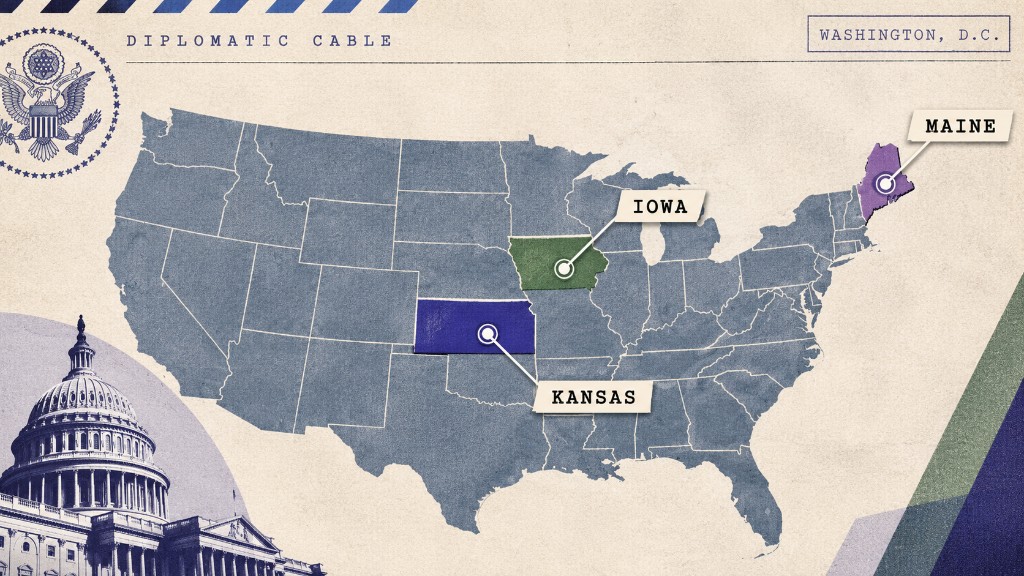
Maine
Collins (R) v Jackson (D)
Whether a local brand can survive her own party’s president, and whether a last-minute tariff carve-out changes anyone’s mind.
Read moreIowa
Hinson (R) v Turek (D)
Trump carried the state by 13. The Senate race is a dead heat, and the reason is the farm economy.
Read moreKansas
Marshall (R) v Hamilton (D)
No Democratic senator in 94 years. If this is close, the cause is the Iran war showing up as diesel, beef, and soybeans.
Read more
Democrats are favoured to win both the House and the Senate by every serious forecaster and the quite unserious social media types as well. The House ranges from 79% to 95% depending on whom you read; the Senate from 57% to 76%. If betting markets are more your thing (tsk tsk), they price a Democratic House at just over 90% and a Democratic Senate at about 70%; put together, a full sweep is about 70%, at time of publishing. The generic ballot average sits around Democrats +8, and no October poll has shown Republicans ahead. It runs as high as +12, and about 50 million Americans had already voted by Sunday morning.
Three races to watch
We are not in the business of predicting races, but three results in particular will tell us most of what we need to know on the night, and each says something different about America and the world.
1. Maine Senate: Susan Collins (R) v Troy Jackson (D)
Collins will tell us whether a long-standing local brand can survive a deeply unpopular president of her own party. She trails Jackson, a former state politician from Northern Maine (we loved this fascinating breakdown of his unique accent) by about three points in the polling averages, and the markets have her as the underdog.
Treat that with a raised eyebrow of scepticism: in 2020, Collins was behind by eight points and ended up winning by eight points. What makes Maine interesting is that it’s almost uniquely exposed to the tariff war with Ottawa, and last month the President carved Maine’s Canadian imports out of his own tariffs to help her. Maine is also one of only two Senate races where the data-centre backlash could plausibly swing the seat (section 3). It is the only tariff in the regime that has moved for electoral reasons (details in section 3). If Collins loses anyway, we can conclude two things: that no Republican is safe from the president’s political stench, and that a last minute political gift isn’t enough to change people’s minds on the tariff regime more broadly.
2. Iowa Senate: Ashley Hinson (R) v Josh Turek (D)
Why care about a state that is entirely flat and full of corn? (We joke, we had the best steak of our lives in Sioux City in 2023.) Perhaps we’ll let noted political analyst John Dickerson answer.
Iowa interests me because it’s the electoral effect of tariffs, diesel, beef and fertilizer in one place.
Trump carried the state by 13 in 2024; two years later, the Senate race is a dead heat, and the governor’s race is competitive. That is almost entirely the farm economy: diesel, fertiliser, Argentine beef and a lapsed farm bill, which section 3 takes apart.
Now, we don’t expect farmers to vote Democratic; the question is whether enough Republicans stay home in a state where the party needs a 2024-sized rural margin to offset the suburbs. This one is close and could go either way.
3. Kansas Senate: Roger Marshall (R) v Adam Hamilton (D)
Kansas has not elected a Democratic senator in 94 years and Trump won the state by 16. This race is tied in the RealClearPolitics average and Cook has it as a toss-up. It matters to a foreign capital in a way that Maine and Iowa do not: it is the purest measure available of what the Iran war costs the President at home.
There are no suburbs to speak of, no Latino backlash, no data-centre fight, no border. If Kansas is close, the only plausible cause is the farm economy, and pretty much every input to the farm economy this autumn is a foreign-policy input: Hormuz for diesel, Buenos Aires for beef, Beijing for soybeans.
Most importantly for us, Marshall sits on the Agriculture Committee and is one of the farm-state Republicans who broke with the President on beef. If senators in 94-year-safe seats come within a point of losing, the Republican caucus that does survive these elections will be motivated, if not able (section 4), to oppose a renewed Iran campaign in November.
Two things to watch for
Foreign interference (as an issue, not an actual thing)
The US embassy in Ottawa has formally accused Canadian ministers Mélanie Joly and Doug Ford and MP Anthony Housefather (a better example of nominative determinism we cannot imagine) of interfering in the midterms over anti-tariff lobbying. Colombia’s new president was also accused of meddling by endorsing a Republican.
Meanwhile, Senate Intelligence Democrats say a classified briefing showed Russia targeting Democrats with AI-generated ads, with Talarico in Texas and Ossoff in Georgia “in particular being dinged”, while the statutorily required threat assessments were never delivered, the FBI’s foreign-influence task force has been disbanded and CISA has lost a third of its staff.
We’re sceptical an outside power can actually swing a race. But what the noise does do is feed the sense that the election is under attack from somewhere, which is useful to anyone who later wants to dispute it. Pew’s Hannah Hartig has Democratic confidence in a fair count down from “over 90%” to 72%.
Will the President accept the result?
To watch him campaign these last months is to watch a man who does not seem to much care whether Republicans win or lose. But he knows his life becomes harder under a Democratic Congress, and we now expect significant post-election claims of fraud. Anne Applebaum thinks the President will “attempt to argue that it’s illegitimate because he will claim so many illegal immigrants voted, and therefore it has to be run,” or to “stop the election based on declaration of some kind of emergency.”
Democrats have war-gamed a presidential claim of foreign interference as the pretext. We do not expect Republicans to refuse to concede en masse, or flee the country Flávio Bolsonaro-style and set up a “Senate-in-exile” from the Turks and Caicos, but we do expect the result to be contested. And we already have a preview: on 26 October President Trump called Lula’s 51.8–48.2 win in Brazil “another rigged election”, with no evidence and before any US recognition. The loser, Flávio Bolsonaro, has since flown to the United States on a State Department visa. Trump’s reaction to a loss abroad might be a good guide to his reaction to one at home.
Lastly, most Americans are not even paying attention to the midterms, but it takes only a few committed people to cause trouble.
03Decisive
Will geopolitics decide any of these races?
We’ve applied a strict test: not “is it an issue” but “could it plausibly swing the seat”. The list is fairly short and the only issue we see across every race is the Iran War and its fallout. A few other issues matter, but most of what we write about every day (Ukraine, China, Gaza, Venezuela etc) is deciding a whole lot of nothing.
Decisive everywhere: Iran, as fuel prices
The war that began on 28 February has run for eight months without a durable ceasefire, and it is on the ballot as the price of fuel. Petrol went from $2.98 the day the war started to $4.28 now. Diesel hit a record above $6.50 in late September and currently sits around $6.20. In AP-NORC’s final pre-election poll, 64% of voters named the war as one of their most important issues, behind the general economy, cost of living and health care, ahead of immigration and crime. Voters who oppose the war favour Democrats by 56 points.
Iran is a domestic issue in America right now. It’s a pocketbook issue.
That is why the generic ballot sits between D+6 and D+12, why Trump’s approval is at 31–36%, and why every Republican in a toss-up Senate seat, including those who backed the war, now calls for a “quick end”. It is also why Trump blocked an Israeli strike planned for around 10 October (the IDF chief reportedly refused strikes he believed were “purely political”), has said publicly that “most people seem to think it’s after the election”, and on 23 October floated “another little Epic Fury”. A third carrier group moved into the region the next day.
While Americans are angry about high prices, they actually opposed this war before it cost them anything: Telhami polled 21% support for military action two weeks before it began.
The only modern American war that has been unpopular since it started.
Almost like promising to end foreign wars and then starting (and losing) a fresh one isn’t good politics.
Three states: the farm economy
This is the economy that makes Iowa, Kansas and Nebraska close. The mechanism is not farmers switching to Democrats but Republican farmers staying home, in states where the party needs a 2024-sized rural margin to offset the suburbs.
Disappointed rural Republicans are unlikely to switch, but the more likely effect is that they stay home.
AP-KFF finds rural Republicans who disapprove of Trump on the economy “substantially less likely” to say they’re certain to vote.
Three foreign-policy related issues are animating voters:
- Argentine beef. Trump quadrupled Argentina’s quota in February and in August opened a 90-day tariff-free window for 300,000 tonnes of lean beef sold “25% below market”, effective 1 September, inside the autumn calf-selling season. Cutter-cow prices have fallen 12%; retail ground beef is down about 2%. Six farm-state Republicans broke with the President publicly (Hinson in Iowa and Marshall in Kansas among them), the Kansas Livestock Association withheld its endorsement of Marshall, and Osborn ran a six-figure ad on it in Nebraska.
- Soybeans. China missed its 2025 pledge to buy American soybeans by more than five million tonnes, and there is lingering distrust that this will solve their problems. Farm bankruptcies are up 46% and the farm bill lapsed on 1 October.
- Diesel and fertiliser. Diesel has been above $6 a gallon through harvest, and anhydrous ammonia, the main nitrogen fertiliser, is 18% above last year, after urea spiked nearly 50% in the spring. 70% of farmers say they can’t afford what they need. Republicans cannot plausibly blame Democrats for Iran-related price increases.
Washington noticed this and is trying to buy back some votes, including the $12bn “Farmer Bridge” implemented back in January, and the Russian diesel deal. Trump flew to the state on 19 October to announce an $8bn diesel-relief programme and credited Marshall for it, in the same fortnight as his diesel deal with Putin and the waiver of the Russia sanctions law that made the deal possible. Rural approval/disapproval fell from 51/48 in June to 40/59 in September and recovered to 50/49 in mid-October, suggesting the money may be working. Elsewhere in places like Texas, Ohio, Montana, the farm story is real but doesn’t appear to be decisive.
Maine: Canadian tariffs
On 23 October the President signed a proclamation removing the 50% Section 338 duties from a list of Canadian goods that matter to Maine’s economy (plywood, paper products, refrigeration equipment, packing crates), effective 30 October. Collins had asked for the relief; Ron Wyden called it a “desperate, 11th-hour attempt” to save her seat. It is the only tariff of the entire regime that has moved for electoral reasons, and it moved for one Senate seat.
While many Americans don’t approve of the administration’s seeming dislike of Canada, the wider US–Canada trade war is barely registering outside the northern border. Michigan is sometimes cited for autos, but that race (Rogers (R) vs El-Sayed (D)) is more about Gaza, Iran and AIPAC than it is about tariffs.
A few seats: ICE conduct, though in Minnesota not the way you might expect
Nationally, immigration has seemingly collapsed as a voting issue: fifth in AP-NORC’s final poll, down from 27% to 8% as a top issue among Latinos (Equis), and Trump’s border approval which was once his best number at 60–65%, is now about even. But many Americans don’t like how immigration enforcement has been conducted: 53% of all voters and two-thirds of Hispanics say the crackdown has “gone too far”, even while majorities still back deportation in principle. That punishes Republicans in heavily Latino districts but it does not make “abolish ICE” a winning position anywhere competitive.
Where it could flip a seat:
- South Texas, above all TX-15. A Trump+18, 82%-Latino district redrawn to favour Republicans, where a Texas Southern University poll (13–16 Oct) has the Democrat Bobby Pulido up 51–44 with Latinos breaking 57–40 for him. This is one of the most obvious races where ICE’s methods could be a decisive issue.
- FL-27. María Elvira Salazar is tied with Eliott Rodríguez after running a September ad telling Trump his enforcement has “gone too far”. The Trump Administration shot themselves in the foot on this one. They ended TPS for Venezuelans last year (the last protected documents lapsed on 2 October), and Cuban and Venezuelan parolees have been swept up in enforcement ever since. Those folks just happened to be Salazar’s coalition.
- Minnesota Senate, but not the way you’d expect. Trump’s year-long campaign against Minnesota’s Somali community (the “garbage” remarks, Operation Metro Surge and its two dead US citizens, the January temporary protected status termination, the 8 October post telling Minnesotans to “fight back”) has turned a Likely-Democratic open seat into a Lean Democratic one. The Democratic candidate’s lead is down to about 3 points. Minnesotans still say the ICE shootings earlier this year were unjustified by 57–61% but, it’s the fraud scandal they’re worried about: 82 of 92 federal defendants in the state’s benefits-fraud cases are Somali-American, and the Republican candidate runs on “fraud, fraud and fraud” as an attack on eight years of Democratic governance at the state level.
Two Senate races: data centres (Ohio and Maine)
Electricity bills across the mid-Atlantic and Midwest are up 1.5–5% since June, and 77% of Americans told Reuters/Ipsos they fear data centres will raise their rates. Moratoria have spread from New York State to Allegheny County to a dozen Iowa counties. Both parties have turned on the AI hyperscalers and the fight is now over whether to make them pay voluntarily or by federal mandate.
It is plausibly decisive in two races, Ohio and Maine. Sherrod Brown’s (D) ads call Jon Husted (R) the “face of data centers” and tie him to a 2019 Google tax break. Husted responded with the Ratepayer Protection Act which passed the House 417–3 but then died in the Senate on 30 September. Inside Elections rates the race a toss-up; Marist has Brown up 48–44.
Trump’s vocal support for AI data centres has become a liability in Ohio that he’s now trying to walk back (as much as he ever walks anything back). He has moved from calling opponents “backwards and poor” in August to declaring on 21 October that data centres are “mandated by me” to generate their own power and pay communities a “dividend.”
In Maine, both candidates have run towards the backlash: Jackson wants data centre approvals slowed while Collins is also publicly sceptical of letting AI data centres rip.
The “we must beat China at all costs” framing of why Americans should support rapid expansion of AI data centres (most pushed by tech investors) has not been persuasive in the areas that matter for these elections.
Not decisive anywhere
Ukraine and Russia
The war in Ukraine and/or US relations with Russia don’t seem to be swinging votes in any poll we could find (or conversation we’ve had). The only electoral story is Russian influence operations.
China
Nothing. Chip export controls, the truce, Taiwan, AI dominance, trade war… none of it appears to be on the top of voters’ minds in any race. Perhaps surprisingly, Chicago Council’s Dina Smeltz says that “a majority of Americans now want to cooperate and have friendly terms with China.”
Gaza
A more complicated story which may move some voters, but seems unlikely to be decisive in any races in and of itself. For example, Abdul El-Sayed beat Haley Stevens in the Democratic primary election in Michigan, despite $30m from AIPAC’s super PAC. Republicans have been attacking El-Sayed’s religion, ethnicity and background, and that may turn voters off him, but that’s only tangentially related to the conflict between Israel and Hamas in Gaza. The polling is also pretty split: 56% of Americans want US assistance to Israel reduced or withdrawn, against 35% in 2014 (Smeltz).
Elsewhere
Venezuela, Cuba, Greenland and NATO. Plenty of noise, and they won’t move any races on the margins.
We think it will be tempting to read the results on 3 November as a verdict on Trump’s foreign policy, in particular Iran. But we don’t think Americans are voting against the War in Iran per se, but rather against the ramifications of the war going badly for the average US voter. The war was unpopular before a shot was fired. Unpopular wars don’t swing Senate seats on their own, but six-dollar diesel sure as heck could.
04A sweep
What a Democratic sweep changes, and why it’s mostly nothing
For the purposes of this briefing, we’re going to consider one outcome only: the Democrats take both the House and the Senate. If the Democrats win the House, they’ll flood the calendar with hearings. But if they win the Senate, they will (in theory) have a say over who runs US foreign policy and how.
Several commentators think that a Democratic sweep would mean the atmosphere of impunity and limitless power around the president will begin to disappear. That’s undoubtedly true, but the practical effect of that may be limited. Even if it politically damages Republicans going into 2028, President Trump will still have considerable ability to act unilaterally, and is likely to have the will to do so.
There are six dynamics worth watching:
- Overriding a presidential veto. If a Democratic Congress passes legislation limiting Trump’s ability to, say, continue the war in Iran, he could simply veto the law. Overriding that veto would take 290 votes in the House and 67 in the Senate. No plausible result gets within thirty of either of those numbers. There is the possibility that Congressional Republicans join with Democrats on certain, bipartisan issues (perhaps Ukraine, Iran, and maybe tariffs), but it’s more likely that very little legislation will be passed by the next Congress, and Trump keeps doing what he wants to do via executive action.
- Congress doesn’t control tariffs. The tariffs now rest on three laws that give the President the power directly, and only new legislation could remove them (see tariffs below).
- None of the trade deals are treaties. Every trade arrangement of the past 18 months is an executive memorandum that Congress never voted on, so there is nothing for it to reject.
- Congress can’t force the president to impose sanctions. Congress passed a Russia sanctions law with veto-proof margins (86–11, 262–159). Two days before it was to take effect, Trump signed a certification suspending it “in the national interests of the United States.” Rebecca Lissner states the principle: “Congress can give the president sanctions authority, but cannot force the president to use it.” That is the pattern for every sanctions statute on the books, so unless President Trump wants the sanctions, there’ll be no new sanctions.
- Congress controls money, but only when new money is needed. The Pentagon has fought the Iran war for eight months on reconciliation money appropriated in 2025. The continuing resolution expires 11 December; the $87.6bn Iran supplemental is stalled, and the FY27 bills reopen in January. That is real leverage for the Democrats; they could for example provide limited funding for the war in return for funding on some of its social priorities, but even that approach is weaker than it looks. Congress, as Heather Hurlburt notes, “has not had any luck forcing the administration to spend money it doesn’t want to spend,” and we suspect Democrats will be in no mood to trust President Trump’s word.
- Sound and fury and subpoenas, signifying not much. The potential committee chairs if Democrats win have already published what they’ll investigate: Meeks at Foreign Affairs (the Iran war, Venezuela), Himes at Intelligence (the Starlink and Patriot throttling of Ukraine), Garcia at Oversight (the Trump family’s foreign business), Courtney at Seapower (the Qatari 747 “gift”, AUKUS), Raskin at Judiciary; in the Senate, Coons at Foreign Relations, Reed at Armed Services, Murray at Appropriations. Democrats expect the White House to ignore their subpoenas.
Congress can give the president sanctions authority, but cannot force the president to use it.
Iran
Changes
There will almost certainly be hearings into the 28 February decision to go to war and another war-powers vote will pass both chambers. Murray has said she “will not rubberstamp tens of billions more” for the war. If a peace deal is signed by the President, the Senate could potentially force a review of the deal under the 2015 Iran Nuclear Agreement Review Act, opening up the terms of the deal to public scrutiny. But Congress could not prevent the deal or change its terms. It can pass a resolution of disapproval, but the President can veto it and the agreement would still stand. The power is narrower: a Democratic Senate can refuse to repeal statutory sanctions permanently, so any deal would rest on presidential waivers that the next president could cancel, exactly as the 2015 deal did.
Doesn't
The war won’t end, at least until Trump is ready. The post-election operation against Iran Trump has been openly mooting is a presidential decision taken before the new Congress sits on 3 January, and even after 3 January Congress cannot stop him. It has two tools and neither works in time: it can pass a war powers resolution ordering the operation to end, which the President can veto (and no such resolution has ever survived a veto). Or it can refuse to pay for the war, but a short campaign runs on money already appropriated, and cutting off funds mid-operation needs a law the President would also veto. What Congress can do is make a long campaign expensive and a renewed one politically costly, but it’s not clear President Trump cares much about political costs anymore.
Why
Because Tehran has read this correctly all along: three senior Iranian officials told Reuters they are stalling to deny Trump a pre-election win and expect the bombing to resume regardless.
Ukraine and Russia
Changes
Most importantly, a Democratic Senate makes it impossible to codify sanctions relief for any peace deal with Russia: the 60-vote threshold that blocks Democrats from imposing sanctions also blocks Trump from lifting them via statute. That will make it much harder for Trump to convince the Russians that sanctions relief could be a reliable part of a deal.
Other than that, the Graham Act waiver will likely get hearings on the Hill and a bill to revoke OFAC licences (which permit transactions otherwise prohibited under sanctions). Meeks’s Ukraine bill ($1bn aid and an $8bn loan authority), which passed the House 226–195, will likely get a Senate vote but still needs 60, so a handful of Republicans either way, and it dies with this Congress on 3 January unless the Senate acts first.
Doesn't
The Shenzhen trilateral meeting between Trump, Xi and Putin on 18–19 November, the Russian diesel licence to April 2027, Starlink and intelligence-sharing decisions, and Ukraine funding cannot be stopped or forced by Congress. Even appropriated money is spendable at the Defense Secretary’s discretion.
Why
The ECFR’s advice to Europeans is how European capitals should view this issue: “treat earmarked funds as intent, not commitment”, and “use Congress for information, not protection.” The Senate’s loudest Republican Ukraine hawk, Thom Tillis, leaves in January whatever happens.
Europe and NATO
Changes
Not much, but two laws get a longer life. Last December Congress barred the Pentagon from cutting US forces in Europe below 76,000 (there are about 80,000 now) without the Defense Secretary certifying to Congress that the cut is in the national interest. The floor covers one year’s money and has to be renewed every December; a Democratic Congress will renew it every time and hold a hearing on every cut. A 2023 law also says no president can leave NATO without two thirds of the Senate or an Act of Congress, and with Democrats in charge nobody will be repealing that. On trade, nothing in the EU file needs a congressional vote. The one live deadline, 31 December, is Brussels’ own: if US duties on steel and aluminium products aren’t down to 15% by then, the Commission can pull the zero tariffs it gave in return.
Doesn't
The posture review. Four sets of options reach Hegseth on 6 November, ranging in one official’s words “from where we are to wherever”, and he decides in December, before the new Congress sits. Everything above the floor is his call: which allies host US troops, the Poland and Romania rotations he has already cancelled, the 5,000 leaving Germany (which keeps the total above 76,000, so breaks no law).
Why
The floor is a certification, not a ban, and Trump’s signing statement said he’d honour it only where it’s “consistent with” his powers as commander in chief. Congress can hold the 76,000 floor, but where the troops above it go is the President’s decision. One EU diplomat on the review this week: “Whatever the outcome, we’ll keep going.”
China and Taiwan
Changes
Congress will become more hawkish than the White House. We expect movement on Nvidia’s chips, including Blackwell (Nvidia’s newest AI processor), whose sale to China the administration currently blocks by regulation, not law. The older H200 chip is allowed into China under a January licence, with 25% of each sale going to the US Treasury. The AI Overwatch Act, which the House Foreign Affairs Committee approved 42 to 2 in January, would write the Blackwell ban into law for at least two years and give Congress a 30 day window to block future chip licences, the way it can block arms sales. Would President Trump veto that law?
We expect noise on Taiwan too. Arms sales have to be formally notified to Congress before they can proceed, and a $14bn package of Patriot missiles and radars that Congress pre-approved in January has sat unnotified since May while the President negotiated with Xi. A Democratic Congress might demand it be sent up because, as Lissner notes: “[Trump has] held up arms sales to Taiwan as a concession to Xi.”
Doesn't
The tariff truce runs to 10 January 2027 because that is as far as Xi would extend it at the September summit. China’s pause on its rare earth export controls, the minerals that chips and weapons depend on, is due to lapse on 10 November. Beijing agreed in September to extend it to January but has not yet published the notice that would do so.
And the H200 chip sales can continue under the licence described above. Each of these is a presidential decision in Washington and Beijing, so Congress can’t do much about them. Trump will keep trying to avoid a fight with Xi, and while a Democratic Congress won’t try to force a confrontation, they’re likely to curtail Trump’s penchant for buddying up to Xi.
Why
Beijing’s analysts are not worried about Congress itself; they are worried about what a weakened Trump does under pressure from it. Wu Xinbo of Fudan University calls the post-midterm period “the main risk point” because a president with no capital at home cannot resist congressional pressure on Taiwan. We think that’s overstated, but it depends on what mood Trump is in after these midterms. He doesn’t really care about Taiwan, so could he be persuaded to authorise arms sales in return for something he wants?
Tariffs, trade deals and Canada
Changes
In February the Supreme Court ruled that the emergency powers law the President used for his 2025 tariffs (IEEPA) does not allow tariffs at all, so the government is now refunding somewhere between $130bn and $175bn to importers. A Democratic Congress will want to know who got paid and who did not, which could uncover some headline-worthy moments.
The House would also pass the Trade Review Act, a bipartisan bill from Chuck Grassley and Maria Cantwell that makes any new tariff lapse after 60 days unless Congress approves it. It needs 60 votes in the Senate and 67 to beat a veto, so we expect it to pass the House and die, even though it’s bipartisan.
The one place Congress gets a real vote is Canada and Mexico: if the President renegotiates the USMCA trade agreement in a way that changes US law, Congress must pass the implementing legislation. Ottawa and Mexico City know that, so a Democratic House gives those capitals considerable leverage.
Doesn't
Not a single tariff rate. After the court ruling, the administration simply rebuilt its tariffs on three older laws that give the President the power directly. Section 232 covers national security, and that is where the 50% on steel and aluminium, the 25% on cars and the pharmaceutical tariffs sit. Section 301 covers unfair trade practices, and in July it was used to put 10 to 12.5% on about 60 economies on the grounds of forced labour in their supply chains. Section 338 is a 1930 law nobody had ever used until the President applied it to Canadian cars, alcohol and dairy in August at 50%.
None of the three tariff regimes can be cancelled by Congress without passing a new law, which brings us back to the veto. The trade deals with Japan, Korea, the EU and the rest are executive memoranda, so there is nothing to ratify and nothing to reject. As one Canadian analyst put it: “If Democrats win in November, the tariffs don’t come off.”
That includes the Canada trade war itself. The US declined to renew USMCA at its 1 July review, so the agreement now gets reviewed every year and expires in 2036 if never extended. Talks with Canada collapsed in August, Canada put counter-tariffs on C$27.6bn of US goods in September, and the President has threatened to double the duties on Canadian cars and steel on 1 January. Only a presidential deal reopens any of it.
Why
Look at Maine (section 3). The only tariff that has moved this year moved by presidential proclamation, to help one senator in one state in the last week of a campaign. The next USMCA review is due by 1 July 2027, with public comments closing on 12 January, nine days after the new Congress sits. By then the shape of any deal will have been settled between the President and two foreign governments, and Congress will be asked to vote only on the parts that need a vote.
Israel and Gaza
Changes
This is where a Democratic Congress could actually change things. 40 of 47 Senate Democrats voted in April to block arms sales, up from 15 a year earlier, and potential incoming Speaker of the House Hakeem Jeffries wants a “major reset” of US–Israel relations. The public is with them (section 3). Congress might try to gum up the works with legislative maneuvers, including putting stronger conditions in funding bills, holding settler-sanction votes and so on, but we also expect significant infighting among Democrats over the next two years on how to handle Israel. Netanyahu and the Israeli embassy in DC will try to exploit those differences between the traditional and more progressive wings of the party to ensure nothing actually gets passed.
Doesn't
Aid to Israel will continue to flow under the existing MOU until 2028. If Congress tries to cut this, the President could exercise his veto. With that said, it is difficult to gauge precisely how Trump views Netanyahu. According to Ricketts: “Trump has fallen out of affection for Netanyahu. I think he feels a bit that Netanyahu talked him into the Iran war.” But if we had to guess, Trump sees more benefit in partnering with Netanyahu than opposing him, he endorsed the Israeli Prime Minister in the recent elections, and the WSJ reports the two are “already planning … strikes right after the US midterms.”
Why
Overlay the 27 October election result in Israel: Netanyahu’s bloc in the low fifties with no path to 61, meaning a repeat election is possible with him as caretaker prime minister. Analyst Ruth Margalit is wary of that situation, noting that “by fomenting this Iran crisis all over again, it will be very hard for [Israeli] opposition leaders to stay out of a national unity government.” A Democratic Congress can’t prevent more military action, and working closely with Israel on Iran strikes might be the most consequential thing he can do as a lame duck president.
AI: chips, data centres and who writes the rules
Changes
The fight over who regulates AI in America ends, and the states win. The administration wants a federal law stopping states like California, Colorado and New York from enforcing their own AI rules, which Washington calls preemption. Congress has already said no three times: the Senate voted 99 to 1 against it in July 2025, it was kept out of the defence bill, and a House compromise never made it to introduction. So in December the President signed an executive order creating a Justice Department task force to sue the states instead. A Democratic Congress can cut that task force’s funding in the annual Justice Department budget, and would.
Data centres get a bill with teeth. Senator Martin Heinrich’s proposal would order FERC, the federal regulator of the power grid, to make data centres pay the full cost of connecting to it rather than spreading that cost across household electricity bills. The Republican version, which asked utilities to do this voluntarily, died in the Senate in September. Heinrich’s gets a floor vote.
And on chips, see China above: Congress moves to put the Blackwell ban into law and give itself a veto over future licences.
Doesn't
The Gulf deals. The Commerce Department has licensed sales of advanced American chips to G42 in the UAE and to Humain in Saudi Arabia. Those are executive decisions, so Congress can hold hearings on them but cannot revoke them. The H200 arrangement with China stays too. And there will be no American version of Europe’s AI Act, which regulates AI systems according to the risk they pose. The United States has no such law, and a Democratic Congress will not write one. Brussels should expect a warmer hearing from the new committee chairs and no US legislation.
Why
Chip licences are executive instruments and the veto protects the rest, so the result is lopsided. A Democratic Congress makes America tougher on Beijing, leaves it unchanged towards Abu Dhabi and Riyadh, and brings it no closer to Europe in law. Beijing has read this already; Paul Triolo expects it to position its rare earth leverage before the new Congress sits in January.
The Gulf
Changes
The Saudi relationship will likely come under closer scrutiny. The $24.3bn F-35 sale was notified to Congress on 17 September, so its review period ran out under a Republican majority. From January, a Democratic Senate can try to attach conditions to deliveries through the defence bill, and it can insist that the US–Saudi defence agreement be treated as what it is: a promise to defend another country that the Senate never ratified.
Abu Dhabi is more exposed, because its biggest wins from this President are exactly the things Democrats have been trying to investigate from the minority. In January 2025 a fund linked to Sheikh Tahnoun bin Zayed, the UAE’s national security adviser, paid $500m for a 49% stake in World Liberty Financial, the Trump family’s crypto venture. Four months later the administration agreed to sell the UAE up to 500,000 advanced AI chips a year, with about 100,000 of them going to G42, the Emirati AI company Tahnoun chairs, and in July the Commerce Department gave G42 licence-free access. Democrats have argued since that the chips were a quid pro quo for investment in the crypto fund, enriching the president’s family. Doha’s exposure is smaller and older: hearings on the $400m 747 it gave the President in 2025 to serve as Air Force One.
Doesn't
Iran’s attacks on the region. Iran’s doctrine since March has been to answer attacks on its infrastructure with attacks on its neighbours’. Cole Busy’s summary: “you hit our water, we hit the Gulf’s water. When you hit our electricity, we hit the Gulf’s electricity.” Riyadh has already absorbed Iranian missiles and a Houthi campaign against its airports that killed more than twenty people this month.
Why
Because the Gulf has stopped waiting for Washington. Riyadh signed a defence pact with Pakistan in August. The Gulf is already asking itself at what point do they decide US bases and US partnership are a liability instead of a protection? A Democratic Congress makes the Gulf’s gains from this President harder to keep and does nothing about the war that makes its cities targets. Riyadh and Abu Dhabi are already talking to Tehran directly, and we expect those talks to turn to each state’s role in the war.
Who runs American foreign policy
Changes
A Democratic Senate stops confirming Trump’s people in bulk. Last year Republicans changed the rules so nominees below cabinet level could be approved in batches, 107 of them in a single vote in October 2025, more than twenty ambassadors among them. A Democratic majority leader never schedules another batch, and Coons at Foreign Relations and Reed at Armed Services decide who gets a hearing at all. Ninety-two of 196 ambassadorships are already unfilled, and any new Defense Secretary or Secretary of State faces a full floor fight.
Doesn't
Who actually sits in the chairs. An acting official can run a department without Senate confirmation. If Hegseth goes, his deputy Steve Feinberg takes over the same day under the Pentagon’s own succession law, and the pattern is set: Todd Blanche ran Justice as acting Attorney General for four months this year, Bill Pulte ran national intelligence for six weeks, and two of the three service secretaries are acting as we write.
Why
The Vacancies Act gives an acting official 210 days, but the clock stops while a nomination is pending, so a nominee the Senate won’t touch keeps the acting official in place indefinitely. Shanahan ran the Pentagon that way for six months in 2019. The courts do eventually bite (two of Trump’s US attorneys were ruled unlawfully appointed last year and their indictments thrown out), but slowly. If the people running State or Defense change after January, they are likely to be acting officials the Senate never voted on.
The new Congress can hold hearings and bargain over funding, but it cannot block a presidential decision on war, tariffs or sanctions. Foreign capitals understand this, and as Lissner puts it, “President Trump may well be the friendliest American leader they ever get.”
05Nine weeks
“Full tilt”: the nine weeks after
Our assessment is that the more consequential date for us, and indeed the rest of the world, is not 3 November but the nine weeks that follow it. According to presidential scholars, lame duck presidents traditionally look abroad to secure their legacy, and the months following midterm elections are historically full of international intrigue. This president has fewer restraints than any of his predecessors had, and a longer list of things he has already said he will do once the vote is out of the way.
Trump unbound, Trump unconstrained, feeling he’s got nothing left to lose.
The weeks ahead
3 Nov
Midterm elections
4 Nov
Official Israeli results
Netanyahu as caretaker, with a strike on Iran as his route to a unity government
6 Nov
Europe force-posture options reach Hegseth
About 80,000 US troops in Europe; the review finishes in December, before the new Congress sits
7 Nov
First Russian diesel tanker docks in New York
The price-cutting deal with Putin lands four days after the vote it was meant to help
10 Nov
China’s rare-earth suspension lapses unless Beijing publishes the extension it promised in September
The first test of how Beijing intends to treat a weakened president
18–19 Nov
Watch
APEC in Shenzhen; proposed Trump–Putin–Xi meeting, without Zelensky
The Kremlin confirmed preparations on 25 October
Late Nov
Watch
The expected Iran operation
Every expert panel’s date for “fireworks”
11 Dec
Government funding expires
The only leverage the Democrats hold, and section 4 explains its limits
14–15 Dec
G20 at Doral; Putin invited
3 Jan
The new Congress sits
Gavels change; everything above has already happened
| Date | What happens | Why it matters |
|---|---|---|
| 3 Nov | Midterm elections | |
| 4 Nov | Official Israeli results | Netanyahu as caretaker, with a strike on Iran as his route to a unity government |
| 6 Nov | Europe force-posture options reach Hegseth | About 80,000 US troops in Europe; the review finishes in December, before the new Congress sits |
| 7 Nov | First Russian diesel tanker docks in New York | The price-cutting deal with Putin lands four days after the vote it was meant to help |
| 10 Nov | China’s rare-earth suspension lapses unless Beijing publishes the extension it promised in September | The first test of how Beijing intends to treat a weakened president |
| 18–19 NovWatch | APEC in Shenzhen; proposed Trump–Putin–Xi meeting, without Zelensky | The Kremlin confirmed preparations on 25 October |
| Late NovWatch | The expected Iran operation | Every expert panel’s date for “fireworks” |
| 11 Dec | Government funding expires | The only leverage the Democrats hold, and section 4 explains its limits |
| 14–15 Dec | G20 at Doral; Putin invited | |
| 3 Jan | The new Congress sits | Gavels change; everything above has already happened |
The China tariff truce runs to 10 January, USMCA public comments close on 12 January and the Russian diesel licence runs to April. Every date in the table is a presidential decision, or a foreign government’s.
Why we read it this way
Every president who has lost a midterm in the past thirty years has reached abroad within weeks, and usually by means that did not need Congress. Even the forecasters are working from the analogy: Nathan Gonzales of Inside Elections built his seat projection on 2006, “the last time there was an unpopular Republican president with a war in the Middle East.”
Clinton, 1994
Within a month of losing both chambers he had the outgoing Congress ratify the Uruguay Round and create the WTO, stopped enforcing the Bosnia arms embargo, launched NATO enlargement, and flew to Budapest to hear Yeltsin’s “cold peace” warning in person.
Bush, 2006
Defense Secretary Rumsfeld was gone the morning after. Within nine weeks Bush had rejected the Iraq Study Group’s drawdown plan and announced the surge instead. The new Democratic Congress passed a resolution against it and then a funding bill with a withdrawal timeline. Bush vetoed the bill, the override failed, and the surge went ahead.
Obama, 2010
A fortnight after the midterms he set the 2014 Afghanistan transition date at the Lisbon NATO summit, concluded the Korea–US trade agreement by executive action while North Korea was shelling Yeonpyeong, and pushed New START through the outgoing Senate 71–26 before Christmas. This is a reminder that a president can bank a priority between November and January when the new Congress begins.
Obama, 2014
Within three weeks he had signed the US–China climate deal by executive agreement, doubled troops in Iraq, extended the Iran talks past their deadline and pushed out Defense Secretary Hagel. On 17 December he normalised relations with Cuba, the largest reversal of his presidency, with no vote in Congress. The Iran deal followed the next summer.
Trump, 2018
Three weeks after losing the House he defied the Senate over Jamal Khashoggi, then signed the USMCA and agreed a trade truce with Xi at the Buenos Aires G20. When the Senate passed the first war powers resolution in its history, on Yemen, the White House ignored it. Six days later he ordered the Syria withdrawal and halved the force in Afghanistan over his advisers’ objections. Defense Secretary Mattis resigned on 20 December and the government shut down two days later.
That is five midterm elections over the last 32 years and each sitting President turned their eye to action abroad within weeks, using executive instruments wherever possible, and in three of the five the defence secretary was gone before Christmas.
Why this time is worse
The brake that worked in 2018 was a Defense Secretary who resigned rather than carry out the order. There is nobody like that in this cabinet. Nate Swanson of the Atlantic Council describes the Iran decision this way: “There is no process. And to the extent there is any debate, it starts and ends at the top.” The people around the President who think a renewed strike is a mistake “don’t say anything.” Anne Applebaum calls it “obeying in advance.”
Hegseth is the one to watch. He arrives at this midterm facing impeachment articles from a Republican, Thomas Massie, who cites the Rumsfeld precedent and will reintroduce them after the vote. He is also the loudest voice inside the building for the operation the President has put off, and he receives the Pentagon’s options for cutting US forces in Europe three days after the election. Nobody has reported that the President intends to remove him. If he does go, Feinberg runs the Pentagon from that afternoon and the Senate need never be asked, as section 4 explains. Whether he is safer or more exposed depends on how the operation he wants turns out.
The two dates that matter most
Iran first. Section 3 has the deferral on the record. What has been added since is the plan. The New York Times reported on 21 October that it is for an operation of “intense but short duration” against energy, nuclear and missile targets. Why the US would foreshadow these attacks is anyone’s guess: there seems to be no political benefit (quite the opposite), and giving Tehran time to prepare doesn’t seem to make a lot of sense either. Rebecca Lissner of CFR reports that the United States “has actually told its Gulf partners to prepare for a renewed military campaign.” Tehran is stalling the talks until after the vote and expects to be bombed anyway.
Then Shenzhen and Doral. A meeting with Xi and Putin, without Zelensky, to try and solve the Ukraine war is the kind of legacy Trump will covet. Two weeks after losing Congress, it is exactly what 2006 and 2018 predict: a term-limited president reaching for the legacy Congress cannot touch. Charles Kupchan calls it “a new kind of Yalta.” The Kremlin confirmed on 25 October that it is preparing for Shenzhen, the Ukraine technical talks in Abu Dhabi fall in the same fortnight, and the President has invited Putin to the G20 at Doral in December, even though he’s an indicted war criminal. None of it needs a vote.
What to expect
Every expert panel we have heard expects the strike and expects it to achieve nothing. The Lawfare panel’s unanimous forecast for New Year’s Day was the “same endless grinding standoff after another round of fireworks in late November,” and Ricketts expects “quite a short-lived military campaign.” Their reasons are the same: Iran’s command structure has already absorbed decapitation, the route of sanctioning China over Iranian oil is dead since Beijing “called our bluff,” the United States is short of interceptor missiles, and Iranian retaliation against Gulf water, power and undersea cables is the limit on how far Washington can go. Cole Busy asks the question Tehran is asking: “what are U.S. bombs going to do that they haven’t already done?”
We agree with all of it, and it does not change our assessment. The risk after 3 November is another round of strikes in the existing Iran war, ordered by a president who has lost Congress and wants to be seen acting, which would change nothing in Iran and cost the Gulf a great deal. And if he contests the result at home, as section 2 expects, the incentive to act abroad goes up, not down. The preview is already in Washington: the man who lost Brazil’s election on 25 October has been in the United States on a State Department visa since Wednesday.
We expect the President to press ahead with the Iran strike, the Shenzhen meeting and the Europe troop cuts before the new Congress sits on 3 January.
06Posts
Quickfire takeaways for posts
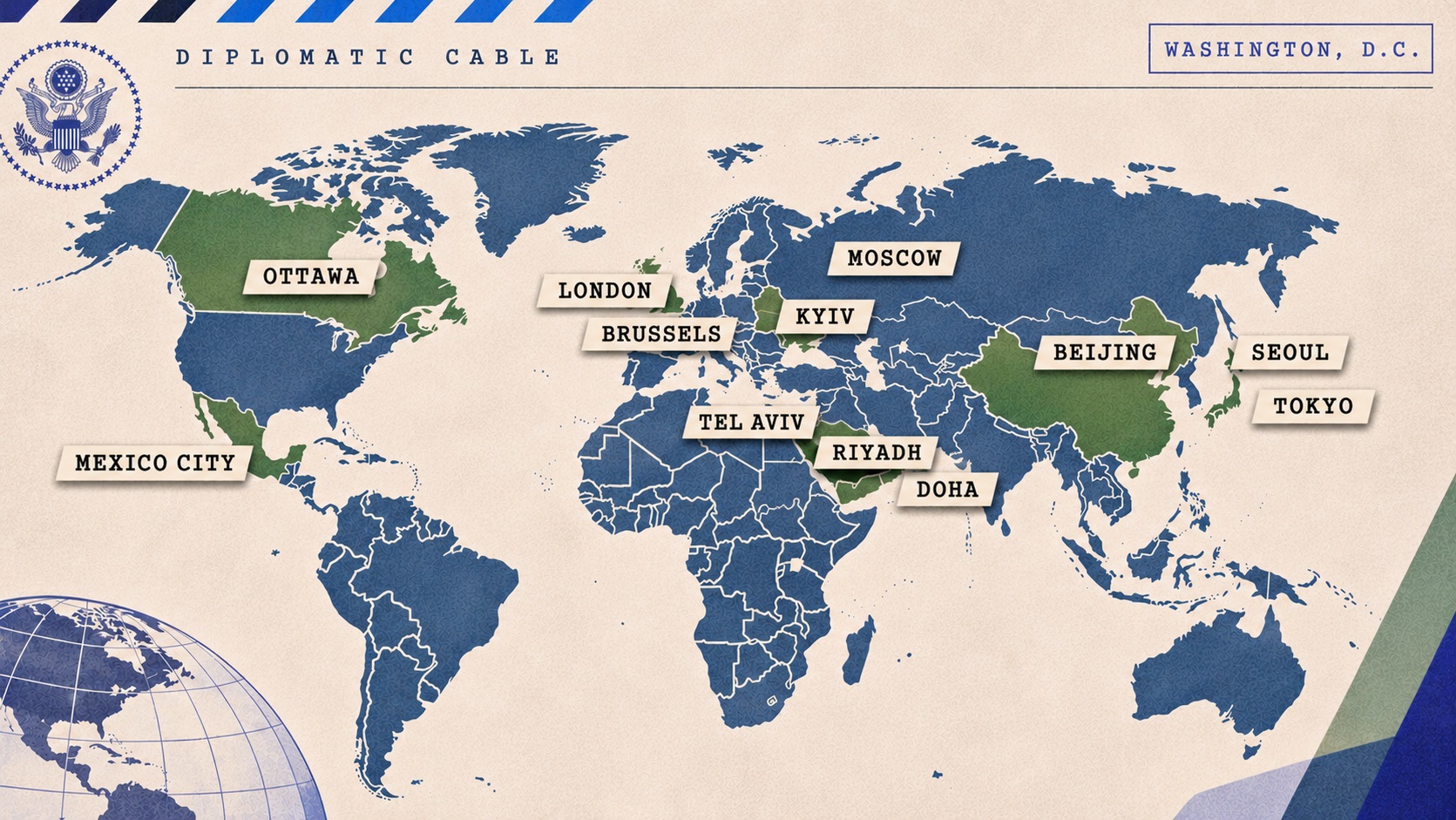
Posts may find the following lines of enquiry useful with host governments in the fortnight after the vote. We are less interested in what each capital says publicly about the result than in what it has already decided to do regardless of it.
1Beijing
2 · 3Tokyo and Seoul
4Moscow
5Kyiv
6Brussels
7London
8Tel Aviv
9 · 10Riyadh and Doha
11Ottawa
12Mexico City
07Comment
Comment
We’re not Americans, but after spending a good deal of time here, we’ve come to think we understand what they want: an America that’s globally engaged but not militarily entangled. Trump promised that but has delivered the opposite, and that will be a big reason for Republicans’ defeat. If they are not defeated, you will need to disregard all of the above and figure out how to advance the national interest on your own.
How President Trump will react to Tuesday’s results is anyone’s guess. Our money is on a violent rhetorical backlash calling the election’s integrity into question that nonetheless stops short of a full-scale effort to overturn the results. With that said, several contacts have told us they worry about another January 6 scenario. We don’t share that worry insofar as Washington is not the focus of these elections, but it would not surprise us to hear scattered reports of violence at polling places and electoral offices across the country.
Multiple political commentators go further, raising the possibility of ICE and even the military shutting down polling places and using reports of irregularities (perhaps illegal immigrant voting?) to issue curfews. This is unlikely (but of course not impossible) and call us cynical but we’re inclined to distrust the cable-TV talking heads who depend on entertaining their audience for a living, not necessarily accurately informing them.
Ultimately, these are midterm elections, not presidential year elections. Most Americans don’t care about them, and many won’t vote. The ultimate result of the midterms will be important in small, technical ways, but mostly unimportant to those wishing to significantly constrain the President. We have intentionally not discussed impeachment because it requires a two-thirds majority in the Senate and is, absent new and shocking behaviour from the president (what even has the capacity to shock at this point?), not realistic. Also, the word count here is already out of control.
Come Tuesday, we expect Americans to deliver a stern rebuke to the President and to Republicans, primarily for making things more expensive and not focusing on their day-to-day needs. As a result, the president will be more constrained domestically, and we therefore expect him to turn his focus outward to foreign relations, where he will face fewer obstacles and receive more ‘love’.
For the Republic of Intrigua, we don’t expect our relationship with the United States to change. We will continue our official, if somewhat unfortunately-phrased policy of “bros where possible, truth-spit when required, and promiscuously diplomatic with everyone else.” (That’s what happens when your president’s media advisers are Gen-Z’ers). The point is we should continue to diversify our foreign relations, supply chains, and economic inputs.
Embassy staff are currently travelling around the US to observe the lead up to the election on the ground. We are pleased to report our initial observation that US coffee has improved markedly (from an admittedly disgraceful base), and a solid flat white can now be had in many areas. A follow-up cable with further observations to follow Tuesday’s results.